
How to Analyze Canadian Exploration Companies: A Filing-by-Filing Checklist
By Golden ShovelAI-drafted from cited sources and checked by an AI editor before publishing.Last updated: November 2, 2026
For information only, not financial or investment advice. Do your own research or consult a licensed advisor. Read our disclaimer.
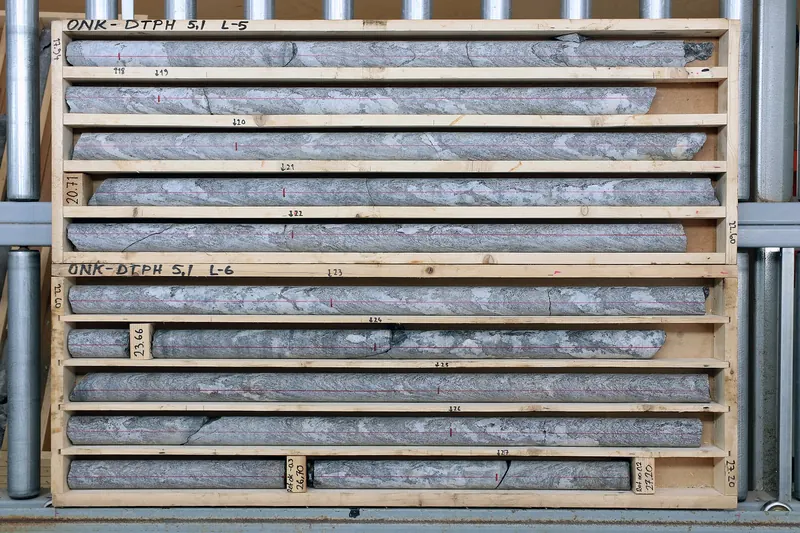
Photo: kallerna, via Wikimedia Commons, CC BY-SA 4.0.
By Golden Shovel
Learning how to analyze Canadian exploration companies mostly means reading their legal filings, not their slide decks. Our junior mining stocks guide explains what juniors are and why people buy them. Our Canadian mining stocks guide covers the exchanges, resources versus reserves and the basics of drill results. This checklist picks up where those guides stop: which documents to pull, in what order, and what to look for in each.
Why the filings matter more than the pitch
Most explorers on the TSX Venture Exchange and the CSE have no revenue, and the odds are long. In 2021 the Prospectors & Developers Association of Canada told a House of Commons committee that only about one in 10,000 mineral claims reaches an advanced exploration stage, and just one in 1,000 advanced-stage projects becomes a mine (House of Commons RNNR report, 2021). That is an industry estimate, not an official statistic. Ontario's government makes the same point without a number: "Only a small number of early exploration programs turn into discoveries" (Ontario, mining sequence).
Step 1: Pull the right documents from SEDAR+
Every Canadian reporting issuer files on SEDAR+. Search for the company, open its profile, and use the option to search and download documents for that profile (SEDAR+ help). For an explorer, pull:
- the latest NI 43-101 technical report for each material property
- the latest annual and interim financial statements and MD&A
- the past year of news releases and material change reports
Step 2: Read the technical report in this order
National Instrument 43-101 sets the disclosure rules (NI 43-101, consolidated June 9, 2023). Form 43-101F1 sets out what goes in the report (Form 43-101F1). The CSA proposed replacing NI 43-101 in 2025, but as of November 2026 the current rule still applies (OSC). These items carry most of what an investor needs.
- Effective date and author. A qualified person (QP) needs at least five years of relevant experience and must be in good standing with a professional body. An independent QP is required in certain cases, including a first-time resource, reserve or preliminary economic assessment (PEA), and a change of 100% or more in total resources or reserves (NI 43-101, s.1.1 and s.5.3).
- Item 3, reliance on other experts. This lists the legal, environmental, tax or political matters where the QP relied on someone else, and the report sections affected.
- Item 12, data verification. The QP must describe how the data were checked, explain any limits on that checking, and give an opinion on whether the data are adequate.
- Item 14, resource estimates. Check the key assumptions and the categories. Inferred, indicated and measured resources must be reported separately, and inferred may not be added to the others (s.2.2). Under the CIM Definition Standards, inferred resources cannot be converted to reserves.
- Item 20, environment, permitting and community. This section summarizes studies, permits and social issues, and shows which approvals are still to come.
- Item 23, adjacent properties. Results from a neighbour's ground can appear only with a statement that the QP couldn't verify them and that they are "not necessarily indicative" of the subject property.
- Item 26, recommendations. The QP's work program must be costed. It may cover no more than two phases, and it must say whether the second depends on positive results from the first. Compare that budget with the cash shown in the MD&A.
Step 3: Test news releases against the rules
Under section 2.3 of NI 43-101, a company may not disclose:
- the quantity or grade of a deposit that isn't a categorized resource or reserve
- economic results based on inferred resources, except a PEA carrying an equally prominent warning that it is preliminary, that inferred resources are too speculative to be reserves, and that there is no certainty the PEA will be realized
- the gross value of metal in a deposit or a drill intercept
- a metal-equivalent grade without the grade of each metal
An "exploration target" can appear only as ranges, with an equally prominent statement that it is conceptual and that further work may not turn it into a resource. A "historical estimate" needs a statement that a QP hasn't classified it as current and that the company isn't treating it as current (s.2.4). Drill results must come with a QA/QC summary, the hole location, azimuth and dip, true widths where known, any much higher-grade intervals inside a reported intercept, and the lab's name and its relationship to the company (s.3.3).
When a company first announces resources, reserves or PEA results that are a material change, it must file a supporting technical report within 45 days. It must also issue a news release that reconciles any material differences (s.4.2).
Step 4: Work out cash runway from the MD&A
Venture issuers must file annual financial statements within 120 days of year-end and interim reports within 60 days of each quarter-end (NI 51-102, consolidated Sept. 22, 2026). An explorer without significant revenue must break down its exploration and evaluation spending property by property in its MD&A, along with general and administrative (G&A) costs (s.5.3). It must also show outstanding shares, options, warrants and other convertibles as of a recent date (s.5.4).
Since March 2026, eligible TSXV and CSE issuers can join a CSA pilot that lets them skip first- and third-quarter interim reports after announcing it in a news release (CSA Blanket Order 51-933). If a company has opted in, its latest figures may be older than you'd expect.
Flow-through money also needs care. A company that issues flow-through shares agrees to spend an amount equal to the proceeds on eligible Canadian exploration and to renounce those deductions to investors (CRA Folio S3-F8-C3). That cash is committed to exploration, not overhead.
Hypothetical example (round numbers): a junior reports $5 million in cash, of which $2 million is unspent flow-through money. Its MD&A shows G&A of $1 million a year. The $2 million will go to drilling, which leaves $3 million to cover overhead and everything else. That covers about three years of G&A, but little drilling once the flow-through money is gone.
Step 5: Read the financing terms
TSXV Policy 4.1 caps the discount on a private placement at 25% for shares trading up to $0.50, 20% from $0.51 to $2.00, and 15% above $2.00. A placement may include at most one warrant per share. The warrant's exercise price can't be below the market price, and its term can't exceed five years. A four-month Exchange hold applies in certain cases, including to shares issued to directors, officers and promoters (TSXV Corporate Finance Manual). The CSE has its own rules.
Watch the overhang. Hypothetical: 20 million units, each with one full warrant, could add 20 million shares if the warrants are exercised. Check the closing news release for the hold-period expiry date and any finder's fees.
Step 6: Check insider trades on SEDI
On SEDI, choose Access Public Filings, then the insider transaction detail report, and search by issuer name (SEDI help). Insiders must file an initial report within 10 calendar days of becoming insiders, and report each change within five calendar days. Option grants can be reported later if the company files an issuer grant report (OSC, insider reporting). The OSC notes that these reports show, "by inference, the insider's views of the issuer's prospects." Separate open-market buying from option exercises.
Step 7: Screen for paid promotion
CSA Staff Notice 51-356 lists warning signs. They include frequent news releases with no new material facts, and name changes to a hot sector with no real plan behind them. They also include paid social-media promoters whose compensation isn't disclosed, and mineral claims that imply potential without sampling evidence (CSA SN 51-356). In British Columbia, investor relations material must disclose "clearly and conspicuously" that it is issued on behalf of the company, near the start, in plain language (BCSC Notice 51-703).
FAQ
Where do I find a junior's technical report? On the company's SEDAR+ profile. A reporting issuer must file one for each material property, and it must file a new one after certain disclosures, such as a first resource estimate.
Is a PEA that uses inferred resources meaningless? No, but it is preliminary by definition, and the rule requires it to say so. CIM's standards say a pre-feasibility study is the minimum needed to declare reserves.
Do flow-through tax benefits pass to people who buy the shares later? No. According to the CRA, only the original investor can claim the renounced expenses.
This guide is general information, not investment, tax or legal advice.
For more, see our company profiles, Canada coverage, and our gold, silver, copper and uranium hubs, or start with our guide to Canadian mining stocks.
Photo: kallerna, via Wikimedia Commons, CC BY-SA 4.0.
How we checked this: AI-drafted from the sources linked above and checked against them by our AI editor.