
Junior Mining Stocks: Understanding the Risks and Rewards
A practical guide to evaluating exploration and development-stage mining companies
By Golden ShovelAI-drafted from cited sources and checked by an AI editor before publishing.Last updated: November 11, 2026
For information only, not financial or investment advice. Do your own research or consult a licensed advisor. Read our disclaimer.
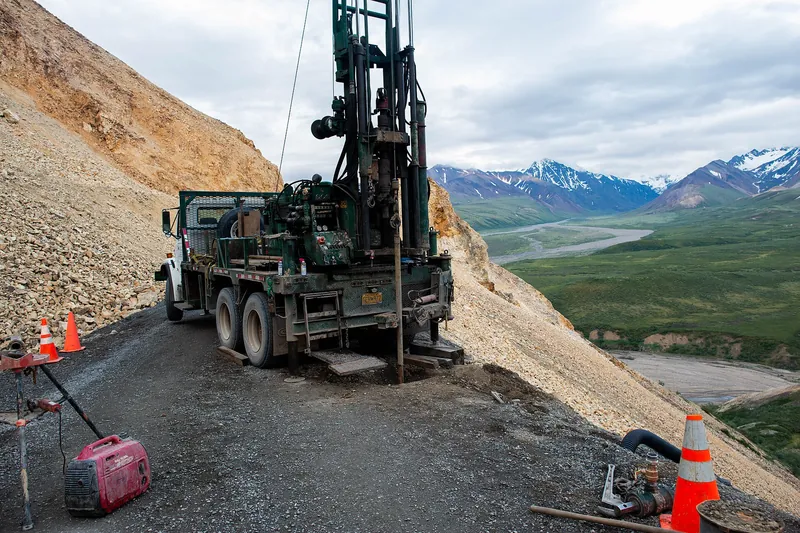
A truck-mounted core drilling rig, shown as a generic example of core drilling. The photo shows geotechnical drilling on the Denali Park Road, Alaska, in 2018, not a mineral exploration site. Photo: Mary Lewandowski, U.S. National Park Service, via Wikimedia Commons, Public domain, cropped.
What Are Junior Mining Stocks?
Junior mining companies are small-cap firms focused on the exploration and early-stage development of mineral deposits. Unlike major producers that generate revenue from operating mines, most juniors are pre-revenue companies that rely on capital markets to fund their activities. They trade primarily on the TSX Venture Exchange (TSXV) in Canada and the OTC markets in the United States.
The appeal of junior mining stocks lies in their potential for outsized returns. A company that discovers a significant mineral deposit can see its share price increase by multiples as the project advances through feasibility studies, permitting, and toward production. However, the failure rate is high. In 2021 the Prospectors & Developers Association of Canada (PDAC) told a House of Commons committee that only about one in 10,000 mineral claims reaches an advanced exploration stage, and just one in 1,000 advanced-stage projects becomes a mine (House of Commons RNNR report, 2021). That is an industry estimate, not an official statistic, but it is why investors need to approach this segment with clear eyes.
The Mining Project Lifecycle
Understanding where a company sits in the project lifecycle is critical for evaluating risk and potential return:
- Grassroots Exploration: The earliest and highest-risk stage. Companies are testing geological theories and may not have identified any mineralization. The probability of finding an economic deposit is low.
- Advanced Exploration: The company has identified mineralization and is drilling to define the size and grade of the deposit. Positive drill results can drive significant share price appreciation.
- Pre-Feasibility / Feasibility: Engineering studies assess whether the deposit can be mined economically. Companies at this stage have a defined resource and are evaluating mining methods, capital costs, and projected returns. The risk profile decreases as technical confidence increases.
- Permitting and Construction: The company has demonstrated economic viability and is seeking regulatory approvals to build a mine. This stage can take several years and involves significant capital expenditure. Financing risk is a key concern.
- Production: The mine is operating and generating revenue. At this point, the company transitions from a junior to a producer, and valuation shifts from speculative to cash-flow-based.
How to Evaluate Junior Mining Companies
Management and Board
In junior mining, management quality is arguably the most important factor. Look for teams with a track record of advancing projects through the development pipeline. Key questions include: Has the CEO built or operated a mine before? Does the geological team have experience in the target commodity and region? Are board members aligned with shareholders through meaningful share ownership?
Project Quality
The underlying mineral deposit determines the long-term value of a junior mining company. Key factors include grade (higher is generally better), size (larger deposits support longer mine lives), metallurgy (how easily the metal can be extracted), and infrastructure access (proximity to roads, power, and water reduces capital costs).
Enterprise Value per Ounce (or Pound)
This is one of the most useful comparative metrics for junior miners. Calculate enterprise value (market cap plus debt minus cash) and divide by the total resource in ounces (for gold) or pounds (for copper, uranium). Comparing this ratio across similar-stage companies in the same commodity helps identify relative value.
Cash Position and Burn Rate
Junior miners consume cash without generating revenue. Check the company's current cash balance, quarterly burn rate, and upcoming financing needs. Companies that need to raise capital in weak markets may be forced to issue shares at depressed prices, diluting existing shareholders.
Common Mistakes Junior Mining Investors Make
One common mistake is over-concentrating in a single stock. Even the most promising junior can fail due to factors outside management's control — a permitting denial, an unexpected geological fault, or a commodity price crash. Diversifying across multiple juniors in different commodities and jurisdictions helps manage this risk.
Another common error is ignoring the share structure. For example (hypothetical numbers), a company with 500 million shares outstanding needs a much larger deposit to generate meaningful per-share value than one with 50 million shares. Always check the fully diluted share count, which includes outstanding warrants and options.
Finally, many investors chase drill results without understanding the geology. A single high-grade intercept does not make a mine. Look for consistent mineralization across multiple drill holes, reasonable widths, and grades that are economic at current metal prices.
Building a Junior Mining Portfolio
Investors who hold juniors often weigh several factors:
- Position sizing: How much to put into any one junior, or into juniors as a group, depends on personal circumstances such as goals, time horizon, other holdings and how much loss you can absorb. There is no standard figure, and a registered adviser can help with that decision.
- Stage: Projects at different stages carry different risks. Early-stage explorers have the widest range of outcomes, including total loss. Advanced-stage developers have better-defined projects but still face permitting, financing and construction risk.
- Commodity exposure: Gold, silver, copper, uranium, and lithium each have different supply-demand dynamics and price cycles.
- Catalyst awareness: Identify upcoming events that could move the share price — drill results, feasibility studies, permitting decisions, or financing announcements. Results can disappoint as easily as they impress, so a catalyst does not guarantee a price move in either direction.
- Exit planning: Junior share prices can rise and fall quickly. Some investors decide in advance under what conditions they would sell; whether and when to sell is a personal decision.
Where to Research Junior Mining Stocks
Reliable sources for junior mining research include company filings on SEDAR+ (for Canadian-listed companies) and EDGAR (for U.S.-listed companies), industry conferences like PDAC and the Beaver Creek Precious Metals Summit, and specialized publications like the Northern Miner and Mining.com. Technical reports filed under National Instrument 43-101 (NI 43-101) in Canada provide detailed geological and economic assessments of mineral projects.
Following experienced mining analysts and geologists on social media and industry forums can also provide valuable insights, though investors should always verify claims against official company disclosures. Canadian regulators have warned about paid promotion that is not disclosed, including on social media (CSA Staff Notice 51-356).
This guide is general information, not investment advice.
Related Topics
Frequently Asked Questions
Related Articles
Nov 18, 2026
Nov 11, 2026
Nov 2, 2026
Nov 1, 2026