
How to Read a Drill-Results Press Release: A Guide for Mining Junior Investors
For information only, not financial or investment advice. Do your own research or consult a licensed advisor. Read our disclaimer.
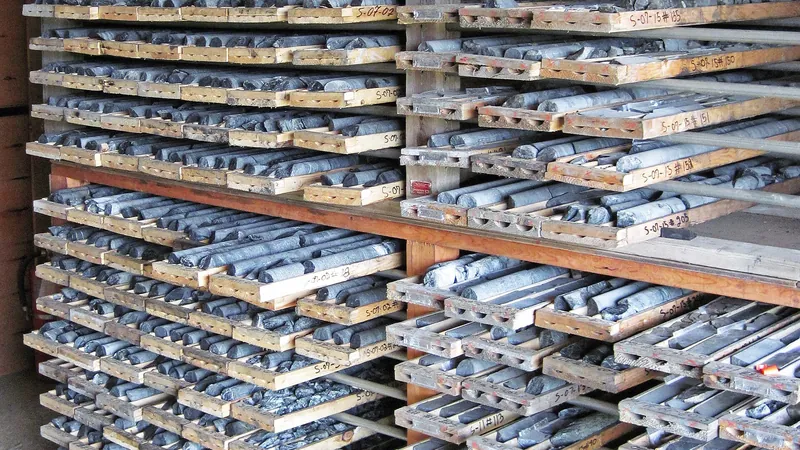
A drill-results press release is often a mining junior's first hard evidence of metal, and its headline is usually the least useful line. This explainer covers what the widths and grades mean, what Canadian rules require the company to disclose, and what the release can't tell you. It is general education and doesn't assess any company's results. If you're new to the sector, start with our junior mining stocks guide.
Start with the intercept, not the headline
A typical headline (a made-up example) reads: "Junior intersects 2.4 g/t gold over 25 metres." That is an intercept: a length of drill core between two depths, with the average grade of the samples assayed along it. The depths in the results table are measured along the hole, which is often drilled at an angle, so they aren't vertical depths below surface.
Intercept length vs true width
Unless the hole crosses the mineralized zone at right angles, the core length is longer than the zone is thick.
Hypothetical example: a hole cuts a flat-lying, sheet-like zone at 45 degrees. The 25 metres of core then represent a true thickness of about 17.7 metres (25 x sin 45°). At 30 degrees, the core interval is twice the true thickness.
That is why National Instrument 43-101, the Canadian rule for mining disclosure, requires written drill results to include each hole's location, azimuth and dip, the sample depths, and the widths and, "to the extent known, the true widths of the mineralized zone" (NI 43-101, s.3.3(2)). If true widths are unknown, read the core length as an upper limit on the zone's thickness.
Grade and units
Precious metals are usually reported in grams per tonne (g/t), where one g/t is one part per million by weight. Base metals such as copper, zinc and nickel are reported in percent (%), and uranium in % U3O8. Toronto Stock Exchange standards ask for industry-standard units "so as not to confuse the reader" (TSX Disclosure Standards).
Two rules help here. A company can't report a metal-equivalent grade (for example, "gold equivalent") unless it also gives the grade of each metal used to calculate it. It also can't state the gross value of metal in a deposit or drill intersection (NI 43-101, s.2.3(1)). If you see an equivalent grade, find the individual grades and the price and recovery assumptions behind it.
Grade x thickness
To compare intercepts, multiply grade by length: gram-metres for gold, percent-metres for copper.
Hypothetical example: 0.8 g/t over 60 metres is 48 gram-metres. 12 g/t over 2 metres is 24 gram-metres. The first hole cut more gold in total; the second is much richer but narrow. Neither says which could be mined profitably; that depends on depth, metallurgy, costs and prices. Use true widths where given, or the comparison will flatter holes drilled at shallow angles.
Highlight-picking
Releases tend to lead with the best interval. Check three things:
- "Including" intervals. A long, lower-grade intercept may contain a short, high-grade one. NI 43-101 requires disclosure of "any significantly higher grade intervals within a lower grade intersection" (s.3.3(2)(d)), so you can see how much the short interval contributes. Hypothetical example: "1.1 g/t over 40 metres, including 15 g/t over 1.5 metres." The short interval holds 22.5 of the 44 gram-metres. Take it out, and the remaining 38.5 metres average about 0.56 g/t.
- Missing holes. TSX standards say results "must not be disclosed selectively": if six holes are drilled and three hit mineralization of interest, details of all six must be released (TSX Disclosure Standards). Count the holes drilled, reported and pending.
- Capping. The same standards list cut (capped) grades among the details to include, so look for whether very high assays were cut.
Assays vs visual estimates
An assay is a lab analysis; a visual estimate is a geologist's judgment from looking at core. TSX standards say visual estimates of the quantity or grade of mineralization "should not be reported." Observations of mineralization should be reported only when assays won't be readily available and the qualified person deems them material, and described so investors don't treat them with the same confidence as assays (TSX Disclosure Standards). A description of visible minerals in core is not a grade.
QA/QC and certified reference materials
NI 43-101 requires a summary of quality-assurance and quality-control measures, the analytical method, the sample size, and each lab's name, location and relationship to the company (s.3.3). The TSX standards add each lab's accreditation, or lack of it.
Industry guidelines from the Canadian Institute of Mining, Metallurgy and Petroleum (CIM) say QA/QC programs should include external blanks, certified reference materials, duplicate samples, and regular check sampling at a third-party lab (CIM Mineral Exploration Best Practice Guidelines, 2018). The guidelines say QC should confirm the accuracy and precision of lab results, across the full range of values, "not just high or unusual results." A certified reference material is a sample of known, certified grade inserted among the real samples; if the lab misses its value, the batch is suspect. Blanks carry no metal and check for contamination. Duplicates test whether results repeat.
The qualified person
Under NI 43-101, scientific and technical disclosure about a material property must be based on information prepared by, or under the supervision of, a qualified person (QP), or approved by one (s.2.1). Written disclosure must name the QP and their relationship to the company (s.3.1), and say whether and how the QP verified the data, and any limits on that (s.3.2). A QP is an engineer or geoscientist with at least five years of relevant experience, in good standing with a professional association (s.1.1).
NI 43-101 requires an independent QP only for certain technical reports (s.5.3), so the QP behind a news release may work for the company. That's why the stated relationship matters. The Companion Policy says the methods for collecting and checking data are the QP's responsibility, and that disclosure that doesn't follow industry practice "could be making misleading disclosure" (Companion Policy 43-101CP, General Guidance (6)).
What the release doesn't tell you
- Whether there is a deposit. NI 43-101 bars companies from disclosing the quantity or grade of a deposit until it has been classified as a mineral resource or reserve (s.2.3(1)(a)). Under CIM definitions, a resource needs "reasonable prospects for eventual economic extraction" (CIM Definition Standards, 2014).
- Continuity. Two good holes far apart don't prove the zone connects.
- Economics. Recovery, costs, permits and infrastructure come later, in studies.
- The company's finances. Cash, spending and dilution matter too. See our Canadian mining stocks guide and our gold mining companies guide.
A short checklist
- Core length or true width?
- Each metal's grade shown beside any equivalent?
- An "including" interval doing most of the work?
- All holes reported, weak ones too?
- Assays, not visual estimates?
- QA/QC summary, lab, relationship and accreditation?
- QP named, with a data-verification statement?
This article is general information, not investment advice.
How we checked this: AI-drafted from the sources linked above and checked against them by our AI editor.
How we produced this article
AI-drafted from cited sources and checked by an AI editor before publishing. See How we fact-check.Related stories
Small Modular Reactors and Mining: Why SMRs Still Aren't on Miners' Shopping Lists
Small modular reactors and mining: why fewer than 10% of miners consider nuclear, which mines are big enough, and OPG's C$20.9B Darlington BWRX-300 plan.

How Mining Royalty and Streaming Companies Work: A Plain Guide for Investors
How mining royalty and streaming companies work: NSR, gross and net profit royalties, upfront deposits, per-ounce payments, key risks and what to read.

Teck Highland Valley Copper: Strike Hits B.C. Mine, but 2026 Guidance Holds
Teck Highland Valley Copper faces a strike, but Teck still sees 2026 output near the top of guidance.

All content on Golden Shovel is for informational purposes only and is not financial, investment, or trading advice.