
Mine Permitting in Canada: How a New Mine Gets Approved
By Golden ShovelAI-drafted from cited sources and checked by an AI editor before publishing.Last updated: November 2, 2026
For information only, not financial or investment advice. Do your own research or consult a licensed advisor. Read our disclaimer.
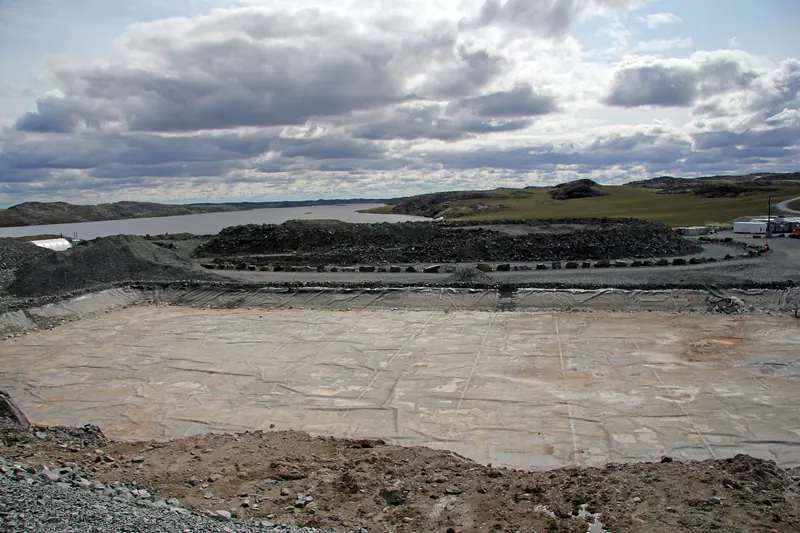
A lined tailings pond at the Hope Bay gold project in Nunavut, photographed in 2012. Photo: Timkal, via Wikimedia Commons, CC BY 3.0.
By Golden Shovel
Mine permitting in Canada is not a single approval. It is a stack of provincial permits, sometimes a federal impact assessment, separate federal authorizations, and the Crown's duty to consult Indigenous peoples, all running at once. This guide explains who decides what, which projects trigger a federal review, and where to check a company's permitting claims. For the investing basics, see our guide to Canadian mining stocks.
Provinces hold most of the power
Provinces have legislative jurisdiction over non-renewable natural resources, including minerals. Uranium mines are an exception, since they also fall under federal rules. So are mines run by federal Crown corporations and mines on federal lands or offshore (Library of Parliament text in House of Commons RNNR report, 2021). Mineral claims, leases, mining permits and closure rules therefore come mainly from provincial law. Each province's system is different. British Columbia and Ontario show how this works in practice.
Permits start at the exploration stage
Even drilling needs permission. In British Columbia, a Mines Act permit must be in place before "any work in, on, or about a mine." That includes drilling, trenching and building access. Exploration permits are applied for through a Notice of Work, which sets out the program and the plan for protecting land, watercourses and cultural heritage resources (B.C., mine exploration).
In Ontario, some early exploration needs an exploration plan or permit under Ontario Regulation 308/12. Before advanced exploration, such as sinking a shaft or taking a bulk sample above the prescribed quantity, a company must lease the claim, consult, and file a closure plan with financial assurance (Ontario, mining sequence).
Building a mine: provincial assessment and closure money
Larger projects face a provincial environmental assessment. In British Columbia, a new mineral mine is reviewable if it will be able to produce 75,000 tonnes or more of ore a year (B.C. Reviewable Projects Regulation). By our calculation, that is roughly 205 tonnes a day, a far lower bar than the federal threshold below.
Ontario requires a closure plan, filed with the province, before mine development can begin. It must include financial assurance certified as enough to pay for rehabilitation. That can be cash, a letter of credit, a surety bond or another accepted form, and it can be posted in phases as the mine is built. Ontario publishes a table of the financial assurance it holds (Ontario, mining sequence).
Federal impact assessment: only bigger mines
The federal Impact Assessment Act applies to "designated projects" listed in the Physical Activities Regulations. The mining thresholds are (SOR/2019-285):
- a new metal mine (other than rare earth, placer or uranium) or metal mill with ore capacity of 5,000 tonnes a day or more
- a new rare earth element mine of 2,500 tonnes a day or more
- a new uranium mine or mill of 2,500 tonnes a day or more outside an existing licensed site
- expansions that grow the mining area by 50% or more and end up above those thresholds
In 2023 the Supreme Court of Canada found the Act's designated-projects scheme largely unconstitutional (Reference re Impact Assessment Act, 2023 SCC 23). Amendments that came into force on June 20, 2024 anchored federal decisions "on areas of clear federal jurisdiction" (IAAC). The Agency gives fish and fish habitat, migratory birds, federal lands and impacts on Indigenous Peoples as examples.
The Act sets time limits, though they can be extended or suspended (Impact Assessment Act):
- Planning. The Agency has 180 days from posting the project description to issue a notice of commencement.
- Information. The company then has up to three years, extendable, to provide its studies.
- Agency report. Once the information is complete, the Agency has 300 days to submit its report (600 days for a review panel).
Separately, the Agency says its coordination lets permitting decisions come no more than a year after complete applications (IAAC process). Under cooperation agreements with most provinces ("one project, one review"), a provincial assessment can in some cases substitute for the federal one. In Yukon, the Northwest Territories and Nunavut, review boards set up under modern treaties run their own processes (Building Canada Act page).
Federal permits most mines need anyway
A mine below the federal assessment thresholds can still need federal permits.
- Fisheries Act. A project that would harmfully alter, disrupt or destroy fish habitat needs a Fisheries and Oceans Canada authorization and an offsetting plan. DFO has 60 days to decide whether an application is complete and 90 days to rule after that. Time for Crown consultation is not counted (DFO).
- Tailings in fish-bearing water. Using a natural water body for mine waste requires adding it to Schedule 2 of the Metal and Diamond Mining Effluent Regulations. That is a regulatory amendment, not a permit. It needs an assessment of alternatives, a fish habitat compensation plan, and public and Indigenous consultation. Environment and Climate Change Canada says the decision can take 6 to 12 months after consultations end (ECCC).
- Uranium. The Canadian Nuclear Safety Commission licenses each phase: site preparation and construction, operation, decommissioning and abandonment. Operating licences usually run 10 to 20 years, and each licensee must hold a financial guarantee for decommissioning. Surface uranium exploration is regulated by provinces (CNSC). For the sector itself, see our uranium stocks guide.
Indigenous consultation runs through every stage
The Crown must consult, and where appropriate accommodate, Indigenous groups when its decisions could harm potential or established Aboriginal or treaty rights. The duty comes from section 35 of the Constitution Act, 1982, and has been affirmed by the Supreme Court in Haida and later cases. It covers permits and authorizations, and consultation must happen before the decision (CIRNAC). Federally, IAAC runs a single "Crown Consultation Hub" for each project and aims to achieve free, prior and informed consent through consultation (IAAC process). Ontario describes consultation with First Nation and Métis communities as continuing throughout the mining sequence.
How long does all of this take? There is no official average. Witnesses told a House of Commons committee in 2021 that permitting timelines in Canada range from three to ten years, and up to 15 in some cases (RNNR report).
The Building Canada Act fast track
The Building Canada Act received Royal Assent on June 26, 2025 (Justice Laws). Cabinet can list a project as being in the national interest, after Indigenous consultation and a 30-day notice in the Canada Gazette. Once a project is listed, the federal approvals covered by the Act are treated as granted together. A single conditions document issued later sets the terms. The Act doesn't change provincial approvals. Referral to the Major Projects Office doesn't guarantee listing, funding or approval (One Canadian Economy).
How to check a company's permitting claims
- Read Item 20 (environmental studies, permitting and social or community impact) of the company's NI 43-101 technical report on SEDAR+.
- Search the Canadian Impact Assessment Registry for federal files, and the provincial registry for provincial ones.
- Separate "application submitted" from "permit issued," and check which level of government each permit comes from.
FAQ
Does every Canadian mine need a federal impact assessment? No. Only designated projects above the regulatory thresholds, or projects the Minister designates, need one. Most mines still need provincial permits and often Fisheries Act approvals.
Does the Building Canada Act override provinces? No. It covers federal approvals only.
Who regulates uranium exploration? The provinces regulate surface exploration. The CNSC licenses mines and mills, and some advanced exploration may need a CNSC licence.
This guide is general information, not investment or legal advice.
For more, see our company profiles, Canada coverage, and our gold, silver, copper and uranium hubs.
Photo: Timkal, via Wikimedia Commons, CC BY 3.0. A lined tailings pond at the Hope Bay gold project in Nunavut, 2012.
How we checked this: AI-drafted from the sources linked above and checked against them by our AI editor.